
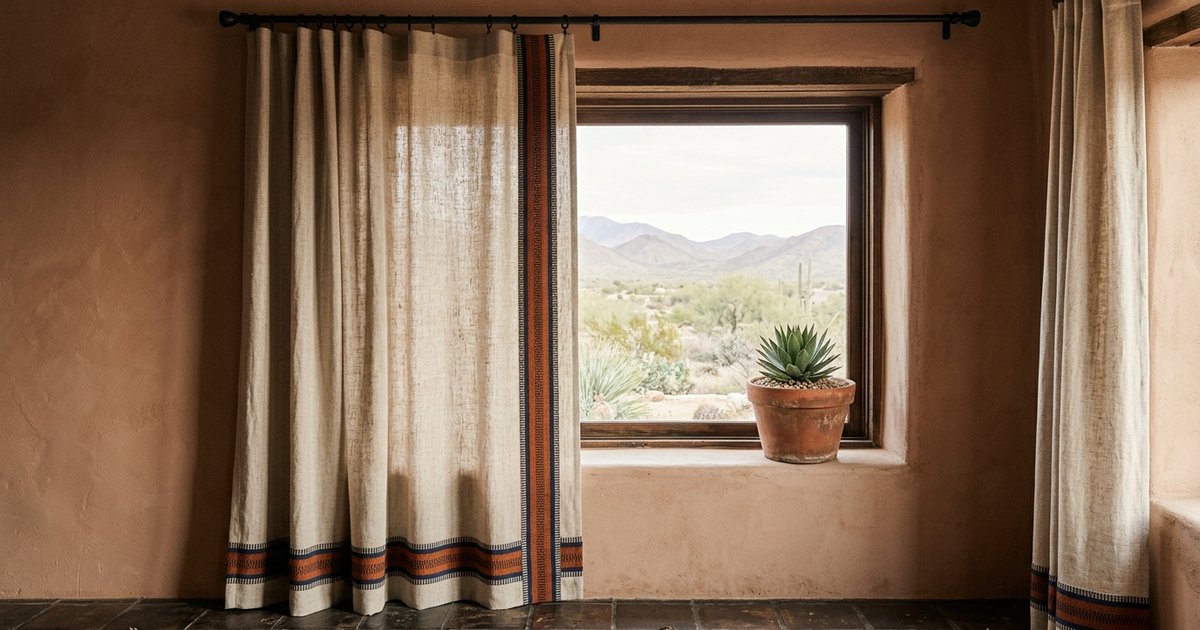
Southwestern curtains are window treatments in natural, textured fabrics and desert-inspired colors, usually earth tones, indigo, rust and cream, often with patterns drawn from the region's weaving traditions: bold stripes, stepped diamonds and geometric centers. They hang well from wood or dark iron rods and suit rooms with warm wood, terracotta and woven rugs. In sunny desert homes, the practical choices matter as much as the pattern: a lined or heavier panel protects the room and the fabric from strong sun. This guide covers the patterns and where they come from, fabrics and colors, sizing, sun control, and how to buy pieces that are honestly labeled.
What makes curtains look southwestern
- Color. Warm, sun-faded hues: terracotta, rust, ochre, sand, cream and charcoal, with blue or turquoise as an accent.
- Pattern. Horizontal bands and stripes, serrated diamonds, stepped or zigzag geometrics and occasional stars.
- Texture. Fabrics that look handwoven or slubby rather than glossy.
- Hardware. Simple wood poles or hand-forged-looking iron rods and rings, without ornate finials.
- Restraint. One patterned element per room usually reads better than pattern on every surface.
The weaving traditions behind southwestern patterns
Many patterns sold as "southwestern" borrow from two major textile traditions of the region: Hispanic New Mexican weaving (often called Rio Grande weaving) and Diné (Navajo) weaving. Knowing a little about each helps you choose a pattern you like and describe it accurately.
According to the National Park Service, Juan de Oñate brought churra sheep to the region in 1598, and by the 1700s they numbered in the hundreds of thousands across the upper Rio Grande Valley. Their wool was the foundation of Native, Spanish and Mexican textiles for the next 300 years. Rio Grande blankets, serapes and rugs were woven on horizontal floor looms introduced by the Spanish, while Diné weavers work on upright looms. When the railroad reached northern New Mexico in 1880, it brought factory-made blankets, commercial yarn and synthetic dyes, which changed how and what weavers made.
Pattern styles you will see
| Style | What it looks like | Background |
|---|---|---|
| Rio Grande stripe | Horizontal bands and stripes on a blanket longer than it is wide | The basic form of Hispanic New Mexican weaving |
| Saltillo | A bordered rectangle with a serrated diamond in the center | Adapted from finer Mexican serapes |
| Vallero | The Saltillo layout plus eight-pointed stars | The first style to develop locally, in the mid-1800s; often vivid because weavers used commercial yarns and aniline dyes |
| Chimayó | Two stripes framing a central geometric design | Developed in the early 1900s, partly for the Santa Fe curio trade |
The weavers of Centinela Traditional Arts in Chimayó note that earlier natural dyes produced "more sedate colors," while later commercial dyes made pieces much brighter. That difference is a useful guide for curtains: muted indigo, brown and cream give a quieter, older look, while saturated reds and oranges feel bolder and more mid-century.
Narrow looms also left a mark. Traditional Rio Grande looms were limited to roughly 30 inches wide, so wider blankets were woven in two panels and seamed down the center, or double-woven with a center ridge. A pair of curtain panels whose patterns meet in the middle when closed echoes that two-panel construction.
Choosing fabric
| Fabric | Look | Best for |
|---|---|---|
| Linen or linen blend | Relaxed, slightly slubby, drapes softly | Living rooms and bedrooms where you want filtered light |
| Cotton canvas or duck | Matte, sturdy, casual | Printed stripes and geometrics; kitchens and family rooms |
| Wool or heavy woven blend | Blanket-like texture and weight | A cozy, cabin or ranch feel; cooler rooms and winter use |
| Cotton gauze or sheer | Light and airy | Layering behind patterned panels, or rooms with indirect light |
Woven-in patterns (jacquard or yarn-dyed) usually look richer than surface prints, but prints are less expensive and easier to find in the exact color you want.
Colors and palettes that work
- Desert neutral: sand, cream and warm gray with a single rust or charcoal stripe. Works with almost any furniture.
- Indigo and natural: blue, undyed cream and brown, close to the palette of early natural-dyed weavings.
- Sunset: terracotta, ochre and deep red. Best on one window or in a room with plain walls.
- Turquoise accent: mostly neutral panels with a turquoise band or border to pick up pottery or tile.
Before buying, hold a fabric sample against the window at different times of day. Strong southwestern sun can make warm colors look orange and wash out pale ones.
Sun, heat and fading
In hot, sunny climates, curtains do practical work. The Building America Solution Center, a U.S. Department of Energy resource run by Pacific Northwest National Laboratory, offers several points worth knowing:
- Interior coverings, including curtains, block less heat than exterior shading, because sunlight has already passed through the glass before it reaches them. They still help.
- In hot climates, protecting against summer heat takes priority, and shading east- and west-facing windows matters most.
- For cooling, close coverings during the day and open them at night when it is cooler outside than inside.
- If heat gain is your main concern, look for products with an Attachments Energy Rating Council (AERC) Warm Climate Rating; higher is better. Ratings exist for many shades and blinds, so you may want a rated shade behind decorative curtains.
Sun also fades fabric. To protect patterned panels:
- Choose lined curtains, or add a lining, so a plain layer faces the window.
- Layer a sheer or a shade behind decorative panels on the sunniest windows.
- Avoid hanging antique or valuable handwoven textiles where direct sun will hit them.
How to size and hang southwestern curtains
- Rod height. Mount the rod a few inches above the window frame; going higher, closer to the ceiling, makes the window look taller.
- Rod width. Extend the rod beyond the frame on each side, commonly about 8 to 16 inches, so open curtains clear the glass and let in more light.
- Fullness. For a full look, total curtain width is usually 2 to 3 times the window width. Bold patterns read more clearly at the lower end of that range, because fewer folds keep the design visible.
- Length. Floor-length panels can stop just at the floor, lightly touch it, or pool. In dusty or high-traffic rooms, a hem just above the floor stays cleaner.
- Measure twice. Measure each window separately rather than assuming matching windows are identical.
Heading styles
- Rings or tab tops: casual and suit wood or iron poles.
- Grommets: slide easily on an iron rod and give even folds.
- Rod pocket: simple and inexpensive, but harder to open and close, so better for fixed side panels.
Room-by-room ideas
- Living room: linen panels in a desert neutral with a woven-stripe border, on a dark iron rod.
- Bedroom: heavier lined panels in indigo or rust for darkness and warmth, with a sheer behind for daytime.
- Kitchen: cafe-height cotton curtains in a small-scale stripe, or a simple valance over a shade.
- Sliding doors: wide, lined panels on a long rod that clears the full door width.
Buying honestly labeled textiles
Plenty of curtains are sold with "southwestern," "Navajo-style" or "Aztec" prints. Designs inspired by regional patterns are fine as long as they are labeled honestly. Claims that a product is Native-made are regulated. The Indian Arts and Crafts Act of 1990 makes it illegal to market a product in a way that falsely suggests it is Indian-made or made by a particular tribe; for example, goods labeled "Navajo" must be made by a Navajo tribal member or certified Navajo artisan. The Act covers Indian and Indian-style arts and crafts produced after 1934, including woven rugs and clothing.
If you want a genuine handwoven piece, for a valance, a door hanging or a textile displayed near (not in) a sunny window, buy from the weavers themselves or from dealers who state the maker and provide written verification. The National Park Service notes that sixth- and seventh-generation weavers still work in the Saltillo, Vallero, Chimayó and Rio Grande styles, and some, such as the Chimayó workshops, sell directly to the public.