
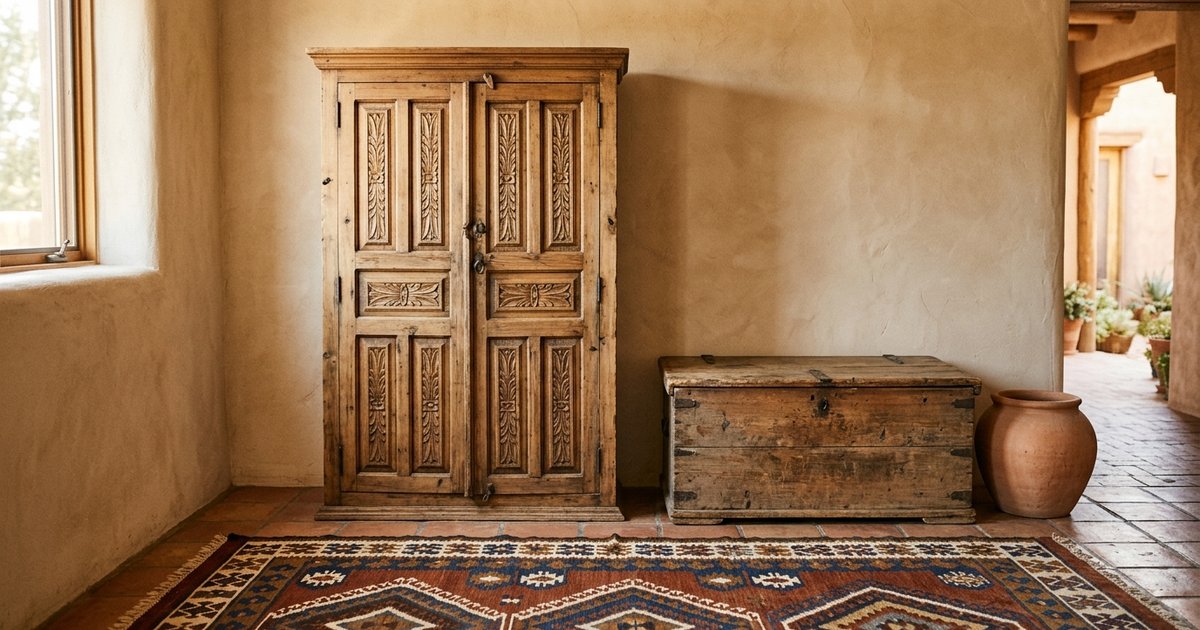
Southwest style furniture is sturdy, simply shaped furniture built from solid wood, traditionally pine, with straight lines, visible joinery and hand-carved or painted decoration such as rosettes, shells and crosses. Its roots are in the furniture that Spanish colonial carpenters made in New Mexico from local wood with basic hand tools, later revived in the 20th century and blended with Pueblo, Mexican and ranch influences. Today the label covers everything from museum-quality Spanish colonial reproductions to rustic pieces in distressed wood, leather and iron. This guide explains where the style comes from, the traditional pieces and their names, how to use it in a living room or bedroom, and how to tell a well-made piece from a quick imitation.
Where southwest furniture comes from
The style begins with Spanish colonists who moved north along the Rio Grande into what is now New Mexico. Importing furniture from Mexico City was expensive, so, as the Harwood Museum of Art in Taos explains, New Mexicans set up their own workshops, where local carpenters (carpinteros) used simple tools to make the pieces households needed.
Several conditions shaped how that furniture looks:
- Local wood. Makers worked mostly in ponderosa pine and juniper. These woods are brittle and tend to crack along the grain, so carpenters kept to straight lines and blocky forms instead of the curving Baroque shapes popular in Spain and Mexico.
- Basic tools. Early makers relied on the saw, the adz and the chisel, which gave pieces their hand-worked surfaces.
- Function first. Settlers valued usefulness above ornament, so early pieces have restrained decoration carved in low relief.
- Scarce metal. Local smiths had few materials, so hinges and locks were modest. Some doors hung on simple interlocking "cotter-pin" hinges, and some cupboard panels were made from tin salvaged from flattened food cans.
In the late 1800s the railroad brought milled lumber and new tools such as the jigsaw, and some makers mixed in Victorian and other American styles. In the 1930s, New Deal vocational programs hired instructors to teach traditional furniture-making and tinwork to a new generation. Benches, tables, chairs and cabinets made by students of one such program in Taos in 1937 and 1938 are, according to the Harwood Museum, still in use in its offices and galleries.
"Spanish colonial" vs. "southwest"
Sven Hanson, writing in Fine Woodworking in 1994, separated the "Rio Grande style of furniture developed specifically in New Mexico," which in its most authentic form is called Spanish colonial, from the looser "Southwestern" label applied to adapted and modernized versions. That distinction is useful when shopping: "Spanish colonial" usually signals traditional forms and joinery, while "southwest style" can mean almost any rustic piece in warm wood and earth tones.
Traditional southwest furniture pieces
Historians commonly group traditional New Mexican furniture into six main types. Knowing the names helps when searching makers and dealers.
| Name | What it is | Notes |
|---|---|---|
| Caja | Chest | Described as the region's most important piece. Used for storage, travel and seating. Variants include the harinero (grain chest) and the hembra (for a bride's trousseau). |
| Trastero | Cupboard or cabinet | The second most common piece. Typically about as tall as its owner and half as wide, with doors of raised panels, spindles or both. |
| Repisa | Wall shelf | Hangs on the wall; useful for pottery and small objects. |
| Silla | Chair | Seating for tables and along walls. |
| Banco | Bench | Seating along a wall or at a table. |
| Mesa | Table | Dining, side and work tables. |
Defining features to look for
- Solid wood with the grain showing. Traditional pieces are left natural or given a light transparent stain.
- Straight lines and heavy proportions. Thick legs, flat panels and square edges rather than delicate curves.
- Exposed joinery. Mortise-and-tenon joints, through tenons that are wedged or pegged, and dovetails left visible at chest corners as part of the decoration.
- Carved motifs. Rosettes, shells (on trastero headpieces, traditionally with an odd number of flutes), crosses, lightning bolts and "bullets," along with older Spanish motifs such as swags, birds, fruit and plants.
- Paint. Some old chests still show traces of blue and red pigment, a sign they were once brightly painted.
- Spindles and tin. Turned spindles in cupboard doors and punched tin panels are both traditional.
Rustic southwest furniture: the modern look
Most furniture sold today as rustic southwest takes those traditional forms and adds a ranch or lodge feel. You will see distressed or wire-brushed finishes, chunkier proportions, upholstery in leather or heavy woven fabric, and hardware in dark iron. These are style choices rather than historical rules, so mix them to suit your space:
- Wood tone: honey or amber pine reads traditional; darker stains read more lodge-like.
- Upholstery: saddle-toned leather, wool, or a striped or geometric woven fabric.
- Metal: black or rust-finished iron for hardware, lamp bases and bed frames.
- Color accents: earth tones, turquoise and deep red, used in textiles and pottery rather than on every piece.
A simple rule for keeping the room from feeling like a theme set is to let one or two pieces carry the carving and color, and keep the rest plain.
Southwest style bedroom furniture
In traditional New Mexican homes, chests and cupboards did most of the work of storage, and those classic pieces translate naturally to a bedroom.
- Bed. A solid wood bed with a carved or spindle headboard, or a plain iron frame, anchors the room. Keep the footboard low if the room is small.
- Chest at the foot of the bed. A caja is the most traditional storage piece in the style; historically chests also served as seating, and one variant, the hembra, held a bride's trousseau. Today it holds blankets and doubles as a seat.
- Cupboard or armoire. A trastero or larger armario gives closet-style storage if built-in space is short. Spindle or punched-tin doors add texture to a plain wall.
- Nightstands. Small square tables or chests with a single drawer, in the same wood as the bed or a deliberate contrast.
- Bench. A wooden banco under a window or along a wall gives seating without a bulky chair.
- Wall shelf. A repisa, or a nicho (a small arched recess in the wall) if you are building or remodeling, holds pottery, candles or books.
For bedding and window treatments, striped or geometric wool blankets and natural fabrics suit the furniture without needing more carving.
Placing southwest furniture in a room
Traditionally, furniture was placed against the walls, leaving the center of the room open. That arrangement still works well with heavy pieces, which can crowd a room when floated in the middle. It also suits the architecture the furniture grew up with. As Tourism Santa Fe describes, the Pueblo Revival style that took hold around 1912 features contoured adobe walls, vigas (exposed log beams), latillas (small poles laid across the beams), nichos and rounded kiva fireplaces in the corners.
You do not need an adobe house to use the style. A few practical ways to adapt it:
- Pair one strong traditional piece, such as a trastero or carved chest, with simpler modern seating.
- Repeat the wood tone at least twice in a room so the piece does not look isolated.
- Give carved pieces space and plain walls around them so the detail reads.
- Use rugs and textiles to bring in color instead of buying painted furniture for every room.
How to judge quality and authenticity
Whether you want a handmade traditional piece or an affordable rustic one, a few checks help.
- Solid wood or veneer? Look at edges and the inside of doors and drawers. Grain that runs continuously around an edge suggests solid wood.
- Joinery. Well-made pieces use dovetail and mortise-and-tenon joints. Staples, visible glue blocks and particleboard are signs of lower-cost construction.
- Carving. Hand carving tends to show small variations; perfectly identical repeated motifs often indicate machine work, which is fine if the price reflects it.
- Origin. Imported Mexican pieces and New Mexican pieces can look similar and are sometimes sold side by side. Ask where and by whom a piece was made.
Laura Morelli's guide to collecting Spanish colonial furniture suggests training your eye at the Millicent Rogers Museum in Taos and the Museum of Spanish Colonial Art and Museum of International Folk Art in Santa Fe, buying directly from makers where possible, and otherwise using a dealer who guarantees authenticity in writing and offers a clear return policy. She points to Santa Fe's juried Spanish Market, held in July and December, as a reliable source of traditional work.
What it costs
Prices depend on whether the maker is known, whether the design and techniques are traditional, and, for antiques, the piece's origin and condition. Morelli's guide gives rough bands: new small pieces from a few hundred dollars, pre-1950 benches and chests in the thousands, and colonial-period pieces reaching five figures at auction. For expensive antiques she recommends an appraiser certified by the American Society of Appraisers or the International Society of Appraisers. Treat these as general ranges and check current prices with makers and dealers.
Caring for solid pine furniture
Because pine and juniper are relatively soft and prone to cracking along the grain, a little care goes a long way:
- Keep pieces away from heating vents, fireplaces and strong direct sun, which dry wood unevenly.
- Use coasters and felt pads; soft pine dents easily.
- Dust with a soft dry cloth and follow the maker's instructions for any wax or oil.
- On antiques, do not strip old paint or finish without advice; original surfaces affect value.