
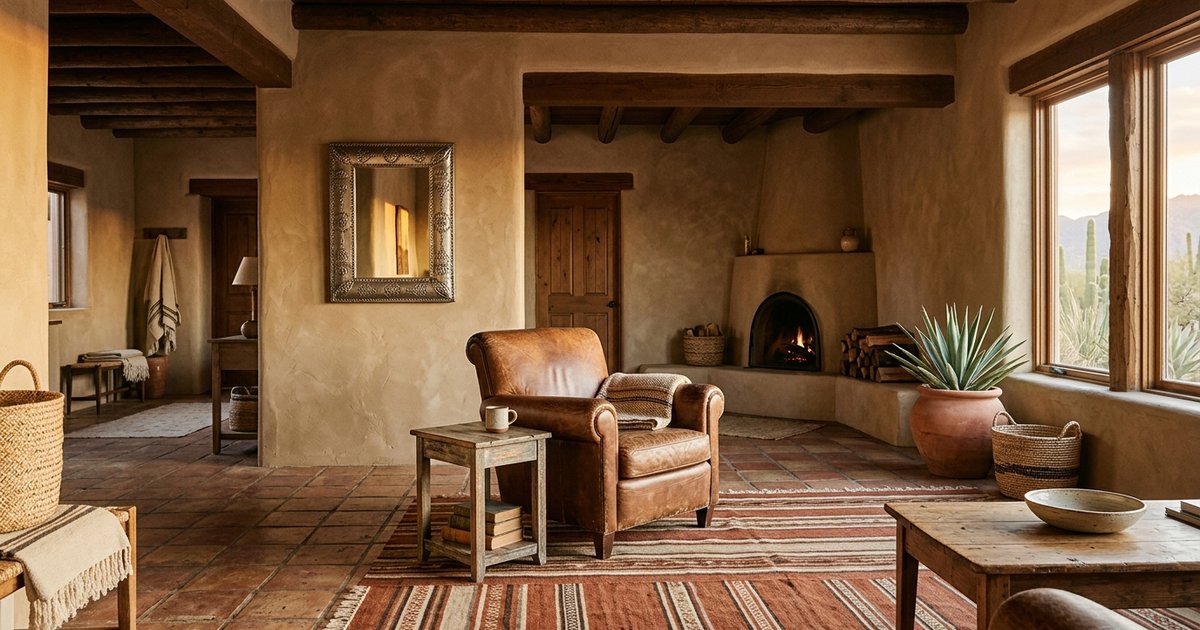
Rustic southwestern decor is a warm, handmade look built from the natural materials of the desert Southwest: plaster or adobe-colored walls, exposed wood beams, unglazed terracotta tile, solid pine furniture, handwoven wool textiles, pottery and simple iron or punched-tin accents, all in an earth-tone palette of clay, sand, rust and sage with turquoise or indigo as accents. It draws on Pueblo, Spanish colonial and Mexican building and craft traditions, and "rustic" means the surfaces look worn, handmade and unfussy rather than polished. You can create the look in almost any house by focusing on texture, a restrained palette and a few authentic pieces. This guide covers where the style comes from, the key materials, room-by-room ideas and how to avoid a theme-park result.
Where the look comes from
Much of what people now call southwestern style traces back to the architecture of northern New Mexico. Tourism Santa Fe describes how Pueblo builders made multistory adobe structures with flat roofs held up by pine logs called vigas, covered with smaller poles called latillas. Spanish settlers introduced wooden molds for uniform adobe bricks, and Spanish Pueblo homes added round walls, corner fireplaces and covered porches called portales around a patio.
The style kept evolving. After the Santa Fe Trail opened in 1821 and U.S. occupation in 1846, the Territorial style added fired brick, milled windows and white-painted posts and trim. Around New Mexico's statehood in 1912, artists and archaeologists pushed to revive the older forms, and the result, with contoured adobe walls, flat roofs, vigas, nichos (small arched wall niches for display) and rounded corner kiva fireplaces, became known as Santa Fe style.
Rustic southwestern decor borrows freely from all of these layers, plus Mexican tile and pottery and ranch-country furniture. You do not need to copy one period exactly, but knowing the sources helps the room feel grounded rather than random.
The core elements at a glance
| Element | Traditional form | How to get the look in a standard house |
|---|---|---|
| Walls | Hand-plastered adobe with soft, rounded edges | Matte paint in warm white, sand or clay; textured plaster finish on a feature wall |
| Ceilings | Vigas and latillas | Decorative wood beams or a single stained-wood ceiling in one room |
| Floors | Saltillo terracotta tile, wood | Terracotta or terracotta-look tile in entries and kitchens; wood elsewhere with wool rugs |
| Fireplace | Rounded corner kiva fireplace | Plastered surround in a warm color; simple wood mantel |
| Display | Nichos built into walls | Recessed shelves, or simple wall shelves for pottery |
| Furniture | Solid pine chests, cupboards, benches, tables | One or two solid wood pieces with visible grain and simple carving |
| Textiles | Handwoven wool blankets and rugs | Wool rugs, striped throws and natural-fiber pillows |
| Accents | Pottery, tin, iron | Clay pots, punched-tin mirrors or lanterns, iron hardware |
Walls, ceilings and color
Walls set the tone for the whole style. The goal is a soft, matte, slightly irregular surface that suggests plaster over adobe.
- Finish: choose flat or matte paint over eggshell or gloss. A hand-troweled plaster or textured finish on one wall adds depth without redoing a whole house.
- Color: warm whites, sand, wheat and soft clay keep rooms bright under strong sun. Save deeper terracotta or rust for a single wall, a fireplace surround or an alcove.
- Edges: rounded corners and arched openings are part of the adobe look; if you are remodeling, ask about bullnose corner bead for drywall.
- Ceilings: exposed beams are the most recognizable feature. Faux beams can work if they are sized realistically and stained to match other wood in the room.
A sample palette
| Role | Colors |
|---|---|
| Walls and large surfaces | Warm white, sand, adobe beige |
| Wood and floors | Honey pine, aged walnut tones, terracotta |
| Textiles | Rust, ochre, charcoal, cream, indigo |
| Accents | Turquoise, sage, deep red |
Floors: terracotta tile and rugs
Unglazed terracotta tile is a classic rustic southwestern floor. The best-known type, Saltillo tile, originates in Saltillo, Coahuila, Mexico. According to Wikipedia's overview of Saltillo tile, handmade tiles come in varying reds, oranges and yellows (manganese types run to light and dark browns), with bumps, chips, color striping and size variations that give them their character. Similar tiles are now made elsewhere in Mexico, and high-fire imitations are also sold.
Before choosing it, know its practical trade-offs:
- It is porous and unglazed, so it absorbs liquids and stains easily unless sealed and maintained.
- Sealing is ongoing. A simple check is to put a few drops of water on the tile; if the water soaks in, it is time for another coat.
- Clean gently. Damp-mop with a neutral cleaner rather than flooding the floor with water.
- Watch the climate outdoors. It is a poor choice for patios in freeze-thaw climates, though popular in warmer regions.
If you want lower maintenance, a porcelain tile made to look like terracotta gives a similar color and typically needs less upkeep. On wood or tile floors, flat-woven wool rugs with stripes or geometric patterns add warmth and soften sound.
Furniture
Rustic southwestern furniture is solid, simply shaped and made of wood with the grain showing. The tradition goes back to Spanish colonial New Mexico, where carpenters used local pine and juniper and basic hand tools to make chests (cajas), cupboards (trasteros), wall shelves (repisas), chairs (sillas), benches (bancos) and tables (mesas). Because the local woods were brittle, makers favored straight lines and restrained carving such as rosettes and shells.
- Pick one statement piece, such as a carved cupboard or chest, and keep surrounding pieces plain.
- Mix in leather or heavy woven upholstery for comfortable seating.
- Place heavier pieces against walls, the traditional arrangement, to keep the middle of the room open.
- Look for real joinery (mortise and tenon, dovetails) if you are paying for "handmade."
Textiles
Woven wool is central to the style. Sheep came to the region with Spanish colonists, and by the 1700s churra sheep numbered in the hundreds of thousands in the upper Rio Grande Valley, supplying wool for Native, Spanish and Mexican weaving. Hispanic New Mexican weavers developed recognizable patterns, including banded Rio Grande stripes, the Saltillo serrated diamond, the star-studded Vallero and the Chimayó design of two stripes framing a center motif. Diné (Navajo) weaving is a separate, equally important tradition.
Ways to use textiles without overdoing it:
- A striped wool throw over a leather or linen sofa.
- One patterned rug per room, with solid pillows and curtains.
- A small handwoven piece hung on a wall as art, out of direct sun.
- Natural linen or cotton for curtains and bedding, with pattern in a border or band.
Be careful with labels. Under the federal Indian Arts and Crafts Act, it is illegal to market a product in a way that falsely suggests it is Indian-made or made by a particular tribe. "Navajo-style" decor is common; a piece sold as "Navajo" should be made by a Navajo tribal member or certified Navajo artisan. Ask sellers to confirm who made a piece before paying a premium.
Pottery, tile and metal accents
Pottery and painted tile
Unglazed clay pots suit the rustic side of the style, while hand-painted glazed ceramics add color. Talavera, the hand-decorated ceramics associated with Puebla and Tlaxcala in Mexico and with Talavera de la Reina and El Puente del Arzobispo in Spain, was inscribed by UNESCO in 2019 on its list of Intangible Cultural Heritage. UNESCO notes that its craft processes retain the same pattern as in the 16th century and that the ceramics have domestic, decorative and architectural uses. In a rustic room, a few painted tiles on a backsplash or stair risers, or a single large vessel, is usually enough.
Tin and iron
Punched and cut tin has deep roots in New Mexico. Early cupboard makers sometimes used tin salvaged from flattened food cans for door panels, and in the 1930s New Deal craft programs in Taos taught tinwork along with furniture-making. Today, punched-tin mirrors, sconces, lanterns and light fixtures add sparkle that suits the matte surfaces of the style. Dark iron works for curtain rods, cabinet pulls, candleholders and bed frames.
Natural elements
- Plants: succulents, cacti and other drought-tolerant plants in terracotta pots suit the look and the climate.
- Wood and stone: a weathered wood bench, a stone or clay hearth, river rocks in a bowl.
- Baskets: woven baskets for storage and display add texture.
- Light: let natural light in during cooler hours, and use linen curtains or shades to soften strong midday sun.
Room-by-room ideas
- Living room: plaster-look walls, a leather or linen sofa, a wool rug, a carved wood coffee table or chest, pottery on a shelf, and a punched-tin mirror.
- Kitchen: terracotta or terracotta-look floor, wood open shelving, a band of painted tile on the backsplash, iron pulls.
- Bedroom: a solid wood or iron bed, a chest at the foot, striped wool blanket, linen bedding in sand or cream, a wall shelf or recessed niche for a few objects.
- Entry: a wooden bench, a woven runner, a mirror, and a large clay pot or basket for umbrellas or blankets.
- Patio or portal: a covered seating area with wood or leather chairs, potted desert plants, lanterns and a woven outdoor rug.
How to keep it from looking like a theme
- Limit the motifs. Choose one or two pattern sources and repeat them, rather than mixing every arrow, cactus and coyote print available.
- Let texture do the work. Plaster, wood grain, wool and clay create interest without pattern.
- Buy fewer, better pieces. One handmade cupboard, rug or pot carries more weight than many mass-produced ones.
- Leave empty space. Traditional rooms kept furniture along the walls and the center open.
- Know what you are buying. Ask who made a piece and where, especially for anything sold as Native-made.